biotech scholarships

Is It Possible To Avoid Genetically Modified Food?

Genetically modified food has divided experts for years. Some say that it is necessary to feed a growing global population whilst others object to GM food on the grounds that it is unethical and poses health risks for both humans and for the natural environment.

Although many consumers are wary about eating GM products, food producers have continued to seek new ways to increase profits and reduce wastage. As a result many everyday products now contain GM ingredients. And GM food may be more prevalent than you expect. In fact, around 90% of the corn grown in the US is genetically modified.

So what exactly does Genetically Modified mean?
Genetically modified foods are produced by making changes to the DNA structure of food crops to give specific benefits. Examples include apples that have been modified not to brown as quickly or potato crops that have been modified to be more resistant to viruses.

How to avoid GM ingredients
It can be difficult to spot which products have been genetically modified, particularly as a large amount of animal feed contains GM ingredients. Even though the eggs you eat might not have been modified themselves, the chicken that laid them may be eating genetically modified feed.

If you want to avoid GM ingredients, the best thing to do is look for labels that state that a product is ‘GM Free’. Alternatively, choose organic products that feature the Soil Association logo.

The Soil Association campaigns against the use of GM ingredients in both human food and animal feed. For more information about the Soil Association, visit: www.soilassociation.org

allan rehab1

Understanding the Benefits of Spinal Rehab

 Understanding the Benefits of Spinal Rehab
Your spine is one of the most vital parts of your body. We rely on it to carry our weight, deliver muscles to adjoining limbs, and to remain strong during times of stress and over use. This major part is also, in part, for controlling blood flow and nerves to different organs and limbs. There are several reasons why the spine can begin to fail us. Vehicle accidents, sports-related injuries, and repetition are ways that the spine can become out of alignment or injured. Back rehab can lead you to a sensible way to getting on the mend, without intrusive surgery.

Spinal Rehabilitation begins with the diagnosis of a trained physician and creates a program that relieves pressure, strengthens tissue, and stabilized the spine. Here at Go Good Guru we have   physical therapy experts can create a program for your personal spine limitations, and work to rehabilitate the precise areas back to a manageable comfort level.

Types of Spinal Impairments
Sciatica is a pain that occurs in the lower back at the sciatica nerve. When this nerve becomes pinched or irritated by another back problem, an electric-type pain can shoot down one of the legs.

A Herniated Disc is becoming common among aging baby boomers. The rubbery inserts, or discs in between the individual vertebrae bones become worn and begin to leak into adjoining nerves. This creates pain or numbness in arms or legs.

Lower back pain can be attributed to normal aging, straining of back muscles, arthritis, herniated discs, injury or illness. It always begins in the lumbar region of the spine and can cause excruciating pain.

Other types of spinal problems include scoliosis, whiplash, rib pain, thoracic pain and neck pain. They are all associated with the spinal column and some type of dysfunction within.

Spinal rehab is instrumental in treatment methods that have been proven and allows the body to naturally mend itself through different types of treatments. Everything from aquatic therapy to total joint rehabilitation are tools that trained specialists use in coaxing the spine to return to a more natural state. If you have had different types of procedures and nothing seems beneficial, you owe it to yourself to visit a clinic where advanced technology and natural healing is used. Learning what your body is going through and how to control is the first step in caring for your spine.

SOURCE…www.yourwellness.com

1948613 1477083061.640x0c1 e1477329132939

Open-Minded People Are More Intelligent, According to Science

While brilliant artists or mad scientists are often stereotyped as social outliers, these people may actually be more intelligent than the masses. A study published in the peer-reviewed scientific journal Social Psychology Quarterly found a connection between evolutionarily novel preferences and/or social values and higher levels of intelligence. In other words, people who are less traditional, more open-minded, and generally go against the grain tend to have higher IQs than those on the opposite side of the spectrum.

“More intelligent people are significantly more likely to exhibit social values and religious and political preferences that are novel to the human species in evolutionary history,” writes Phys.org of the study. “Specifically, liberalism and atheism, and for men (but not women), preference for sexual exclusivity correlate with higher intelligence.” For reference, “evolutionarily novel” refers to preferences and values that our ancestors were not biologically designed to have. It’s a tendency to think and live far outside of the box, if you will.

“General intelligence, the ability to think and reason, endowed our ancestors with advantages in solving evolutionarily novel problems for which they did not have innate solutions,” said Satoshi Kanazawa, an evolutionary psychologist at the London School of Economics and Political Science, of the study. “As a result, more intelligent people are more likely to recognize and understand such novel entities and situations than less intelligent people, and some of these entities and situations are preferences, values, and lifestyles.”

SOURCE…www.mydomaine.com

breath e1476993740195

Breathing For Your Better Health


Take a deep breath and relax….

Behind that common piece of advice is a complex series of physiological processes that calm the body, slow the heart and help control pain. Breathing and controlling your breath is one of the easiest ways to improve mental and physical health, doctors and psychologists say. Slow, deep and consistent breathing has been shown to have benefits in treating conditions ranging from migraines and irritable bowel syndrome to anxiety disorders and pain.

“If you train yourself to breathe a little bit slower it can have long-term health benefits,” said Murali Doraiswamy, a professor of psychiatry at Duke University Medical Center in Durham, N.C. Deep breathing activates a relaxation response, he said, “potentially decreasing inflammation, improving heart health, boosting your immune system and maybe even improving longevity,”

To help foster the habit of healthful breathing, a San Francisco technology startup recently launched a wearable device called Spire that tracks breathing patterns and tells users when they are too tense or anxious. “One of the goals of this work was, ‘How do you make it so simple to shift into calm or focus that people don’t have to stop what they’re doing?’” said Neema Moraveji, co-founder of Spire and director of the Calming Technology Lab at Stanford University.

Many early buyers of the $150 Spire are office workers who spend a lot of time on computers. Research has found people working on computers often hold their breath, an action referred to as screen apnea, he said. Belisa Vranich, a New York City-based clinical psychologist, has been conducting breathing workshops around the country for just over a year. Among her biggest clients: corporate managers eager to learn how to better manage stress.

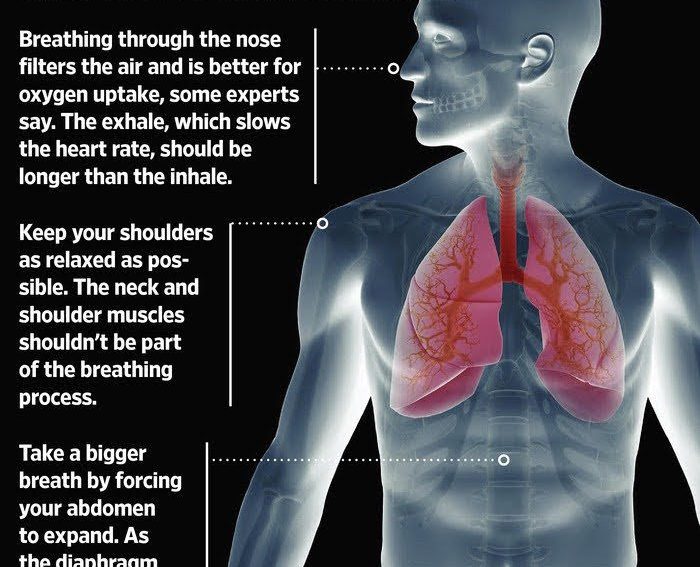
Dr. Vranich says she instructs clients to breathe with their abdomen. On the inhale, this encourages the diaphragm to flatten out and the ribs to flare out. Most of us by instinct breathe vertically, using our chest, shoulders and neck, she says. Abdominal, or diaphragmatic, breathing is often taught in yoga and meditation classes. Experts say air should be breathed in through the nose, and the exhale should be longer than the inhale. Dr. Vranich recommends trying to breathe this way all the time but other experts say it is enough to use the technique during stressful or tense times or when it is necessary to focus or concentrate.

Slow breathing stimulates the vagus nerve, which runs from the stem of the brain to the abdomen. It is part of the parasympathetic nervous system, which is responsible for the body’s “rest and digest” activities. (By contrast, the sympathetic nervous system regulates many of our “fight or flight” responses.) The vagus-nerve activity causes the heart rate to decrease as we exhale, said Richard Gevirtz, a psychology professor at Alliant International University in San Diego. Vagal activity can be activated when breathing at about five to seven breaths a minute, said Dr. Gevirtz, compared with average breathing rates of about 12 to 18 breaths a minute.

The vagus nerve’s response includes the release of different chemicals, including acetylcholine, a neurotransmitter that acts as an anti-inflammatory and slows down digestion and the heart rate, said Stephen Silberstein, director of the Jefferson Headache Center at Thomas Jefferson University in Philadelphia who is working on an article on the vagus nerve and its functions.When medical conditions are severe, such as with epilepsy, medical devices are sometimes implanted to stimulate the vagus nerve. For most people, slow, steady breathing is a natural way to stimulate the nerve. Certain conditions, including asthma and panic disorders, have been shown to benefit from a different breathing technique—taking shallow breaths through the nose at a regular rhythmic speed of eight to 13 breaths a minute. For these patients, already anxious about their symptoms, deep breathing can cause them to take in too much air and hyperventilate.

Heart-rate-variability biofeedback uses breathing to train people to increase the variation in their heart rate, or the interval between heartbeats. The technique has been shown to have benefits for conditions including anxiety disorders and asthma. Biofeedback also makes breathing more efficient, said Paul Lehrer, a clinical psychologist at Robert Wood Johnson Medical School, part of Rutgers University in New Jersey. On average most people reach this balance when breathing 11 seconds per breath.

Spire, the device that tracks individual breathing patterns, is a pedometer-like device that can be clipped onto pants or a bra strap and can sense breathing patterns without touching the skin. A sensor detects subtle torso expansions and contractions, said Stanford’s Dr. Moraveji. The device identifies people’s baseline breathing patterns and can tell users when they are tense or may need to take a deep breath. It includes an app that guides people in breathing exercises as short as 30 seconds.

Dr. Moraveji’s research includes a 2011 Stanford study of 13 students that found subjects on average took 16.7 breaths a minute when they were doing normal computer work compared with 9.3 breaths a minute when they were relaxed, he said. The study was published in the proceedings of the annual ACM Symposium on User Interface Software and Technology.

A follow-up study involving 14 subjects found that giving feedback of breathing patterns on a computer screen allowed the subjects to control their breathing without decreasing their performance on an analytical task, Dr. Moraveji said. “We proved that because the breath is so easily controllable, you don’t have to interrupt your task in order to regulate your nervous system,” he said. The study was presented at the ACM CHI Conference on Human Factors in Computing Systems in 2012.

Dr. Vranich, the breathing coach, believes teaching people to unlearn dysfunctional breathing habits requires practice and exercises. Her group classes cost $150 for a three-hour workshop and private classes range from $350 to $450. On a recent afternoon, she held a private session in her Manhattan studio with Joe March, a 40-year-old New York City firefighter who said he wanted to improve his lung capacity and condition for Brazilian jujitsu, a form of martial arts he practices.

Dr. Vranich positions many of her clients upside down, to better exercise the diaphragm muscles. She assisted Mr. March into a shoulder stand against a wall as she monitored his breathing. “Inhale, relax, and see if you can expand right by your diaphragm,” she said. “Exhale, squeeze your ribs at the same time.”

Earl Winthrop, a 60-year-old partner of a Boston wealth-management firm, is another of Dr. Vranich’s clients. “When I was working on the computer, I wasn’t breathing properly,” said Mr. Winthrop, who now does tailored breathing exercises and short bouts of meditative breathing. “I’m much more aware now. I feel more focused. I can calm myself down,” he said.


SOURCE…http://www.wsj.com

gmo salmon versus regular salmon1

Consumers Opposed To Genetically Modified Foods, But Don’t Know What They Are


A new report finds Canadians are critical yet overwhelmingly confused about food that has been genetically engineered, but they want mandatory labels to help inform their grocery choices.A research report commissioned by Health Canada finds consumers have “strong feelings” about being able to identify genetically modified products when they’re shopping, and 78 per cent are calling for clear labelling on packages.

“There was a prevailing belief among participants that there should be greater transparency to consumers and, once raised, many questioned why government in particular should be resistant to providing consumers with more information that would help them make more informed decisions,” read the findings from The Strategic Counsel.

Given the choice, 62 per cent would buy a non-GM food over a GM product out of fears of health hazards or impacts on the environment.

Consumers don’t understand science

But the research, which was conducted through focus groups and online surveys to gauge public perceptions, also reveals that consumers have little understanding about the science of what many dubbed “Frankenfood.” Often, it’s confused with goods that have had additives like preservatives or hormone injections.

“Lack of awareness and understanding affects their confidence in the food supply and raises their level of concern,” the report says.Some of the words commonly used by participants included “fake,” “mutations,” “man-made” or “mass produced.”According to Health Canada’s website, all GM foods are “rigorously assessed” for safety prior to being allowed on the market. But labelling is now voluntary.

NDP MP Pierre-Luc Dusseault says Canadians have every right to know what they’re eating, and he has tabled a private member’s bill to require mandatory labels.”The more information we give to consumers, the better,” he said.

He pointed to a new GM labelling law in Vermont that requires processed foods sold in the state that contain genetically engineered ingredients to say so on the label. Similar laws exist in countries across Europe.But negative views revealed in the research highlight a “difficult challenge” for Health Canada ahead.Anti-GM advocates have successfully filled the “information void,” the report reads.”Consumers’ initial response and reaction to the topic of GM foods is certainly not positive and clearly presents some formidable challenges for Health Canada communicators and policy-makers with respect to addressing the level of confusion, misinformation and generally low awareness/understanding that currently exists.”

Pushback’ expected

According to Health Canada’s website, a GM food is one derived from an organism that has been changed through:

  • Traditional crossbreeding techniques.
  • Using chemicals or radiation to alter genetic makeup.
  • Introducing a gene from one species into another species.

A company typically takes seven to 10 years to research and obtain approval for sale, and only 120 genetically modified foods have been approved by Health Canada to date, ranging from insect-resistant corn to genetically modified yeast that cuts certain compounds in wine.

In May, Health Canada provoked controversy when it approved the first genetically modified food animal  for sale after “rigorous” scientific reviews.

While a high number of participants opposed GM food in any form, the report said regulatory, safety and approvals processes could give greater comfort to those “sitting on the fence.”

“However, the extent of likely pushback cannot be underestimated. From the survey, only 26 per cent of respondents indicated they would be comfortable eating foods that have been genetically modified, and just 22 per cent support the development and sale of GM foods in Canada. It is clear that significant efforts to inform and educate Canadians would be required in order to shift views in a more positive direction.”


Other findings:

  • The argument that genetic modification helps produce more affordable, sustainable food draws some empathy for developing nations where population growth and supply of arable land are challenges, but hold “little sway” in Canada, one of the world’s leading agricultural producers.
  • Consumers aren’t convinced that GM foods are as safe, tasty or nutritious.
  • Most see the market for GM foods as one created as a means to increase corporate profits, not to address demand or evolving preferences.
  • Consumers are just as concerned about GM as they are about herbicides and pesticides and growth hormones.

The research, carried out by The Strategic Counsel for a cost of $119,000, was completed in late June and recently publicly posted online.

It was based on focus groups in five centres and an online survey of 2,018 respondents. Data is based on an online survey of 2,018 Canadians, aged 19 years and older between March 24 and March 29, 2016. A margin of error is not available due to the sampling method for the survey.

Consumers opposed to genetically modified foods, but don’t know what they are
http://news360.com/article/372958975

Shared via News360

istock 000014103156medium 21c05b33b46c5dbf21d77771dc3ca8e6e5a16b36 s800 c85

Why Eating TOO Much Meat Harms Mother Earth

Sorry to ruin your appetite, but it’s time to talk about cow belches.

Humans the world over are eating meat and drinking milk — some of us a little less, some of us a lot more, than years past. Farmers are bringing more and more cows into the world to meet demand, and with them escapes more methane into the atmosphere.

In 2011, methane from livestock accounted for 39 percent of all the greenhouse gas emissions from agriculture, according to a report that United Nation’s Food and Agriculture Organization released Friday. That’s more than synthetic fertilizer or deforestation. Methane from livestock rose 11 percent between 2001 and 2011.

The bulk of the emissions — 55 percent — came from beef cattle. Dairy cows, buffalo, sheep and goats accounted for the rest.

Those emissions, combined with emissions from all the other sectors of food production, aren’t likely to go down anytime soon. Greenhouse gas emissions from agriculture, forestry and fishing have doubled over the past 50 years, according to the report. Emissions could go up by 30 percent by 2050.


All this talk about cow belches might make you want to give up meat. So should we all become vegetarians? Asking everyone to reduce their meat consumption isn’t a very practical strategy, says Francesco Tubiello, a natural resources officer for the FAO.

The demand for meat is rising most quickly in developing countries. And since the diets of many in the developing world are short on protein and calories, the poorest of them could really benefit from more meat production. Plus, “for many developing countries, agriculture is their main economic sector,” Tubiello tells The Salt.

Global meat consumption is likely to keep going up over the next 30 years, Tubiello says. (Though, as many have argued, it does make sense for the affluent people of the world who currently over-consume meat to cut back.) But the FAO says the best way to reduce agriculture’s contribution to global warming is to tackle other sources of emissions.

For example, we could improve how efficiently we use agricultural land. “There are many ways to improve the productivity of land,” Tubiello says, like increasing crop yields. That means we need to find more ways to use less land to make the same amount of food.

Encouraging farmers to use fertilizers more judiciously would also help. When farmers spray their fields with nitrogen fertilizer, microbes in the soil convert it to nitrous oxide, a powerful greenhouse gas. “A lot of the fertilizer is not used efficiently,” Tubiello says.


The FAO report found that fertilizers accounted 14 percent of agricultural emissions in 2011. And the amount emissions from fertilizers has risen 37 percent since 2001.

Of course, we can’t ignore the fact that raising livestock takes a huge toll on the environment. But, Tubiello says, there are ways to mitigate the environmental impact of raising livestock without doing away with meat altogether.For example, we could also try to switch up what we feed cows. Having cows graze on grass isn’t a very efficient use of land, as the grass makes for smaller animals, who end up emitting more greenhouse gases per pound of meat produced, than animals raised on grain.

However, corn and soy that most cows eat makes them especially gassy, so feeding them alfalfa and supplements could reduce how much they belch. More research on how to optimize what we feed livestock could help farmers reduce emissions.But even if we can’t control how much cows belch, we can control what we do with their poop. When nitrogen in livestock manure and urine is also broken down into nitrous oxide — and emissions from manure accounted for 16 percent of agricultural emissions in 2011, according to the FAO. Managing all that manure — or even reusing it as fuel, is one way to reduce emissions.


SOURCE…www.npr.org/