Category Archives for "Good Mind"

neuroscience exercise neurosciencneews1

Is Vision More Sensitive During Exercise?

Psychologists design an experiment to investigate whether human vision is more sensitive during physical activity.

It’s universally accepted that the benefits of exercise go well beyond fitness, from reducing the risk of disease to improving sleep and enhancing mood. Physical activity gives cognitive function a boost as well as fortifying memory and safeguarding thinking skills.

But can it enhance your vision? It appears so.

Intrigued by recent findings that neuron firing rates in the regions of mouse and fly brains associated with visual processing increase during physical activity, UC Santa Barbara psychologists Barry Giesbrecht and Tom Bullock wanted to know if the same might be true for the human brain.

To find out, they designed an experiment using behavioral measures and neuroimaging techniques to explore the ways in which brief bouts of physical exercise impact human performance and underlying neural activity. The researchers found that low-intensity exercise boosted activation in the visual cortex, the part of the cerebral cortex that plays an important role in processing visual information. Their results appear in the Journal of Cognitive Neuroscience.

“We show that the increased activation — what we call arousal — changes how information is represented, and it’s much more selective,” said co-author Giesbrecht, a professor in UCSB’s Department of Psychological and Brain Sciences. “That’s important to understand because how that information then gets used could potentially be different.

“There’s an interesting cross-species link that shows these effects of arousal might have similar consequences for how visual information is processed,” he continued. “That implies the evolution of something that might provide a competitive advantage in some way.”

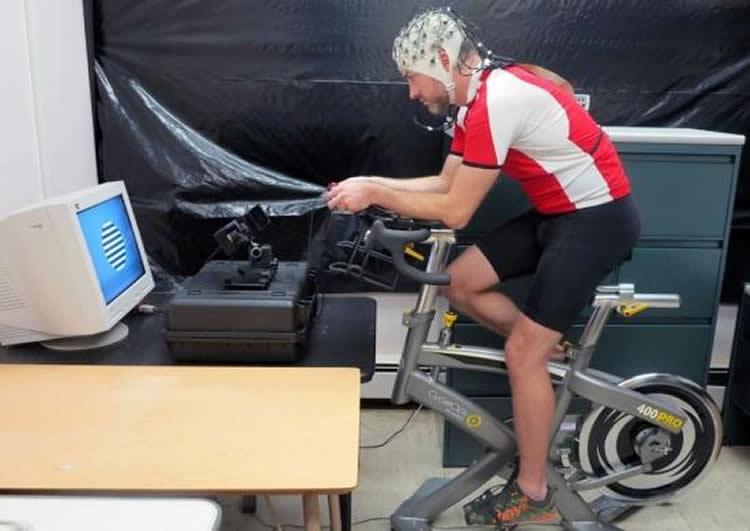
To investigate how exercise affects different aspects of cognitive function, the investigators enlisted 18 volunteers. Each of them wore a wireless heart rate monitor and an EEG (electroencephalogram) cap containing 64 scalp electrodes. While on a stationary bicycle, participants performed a simple orientation discrimination task using high-contrast stimuli composed of alternating black and white bars presented at one of nine spatial orientations. The tasks were performed while at rest and during bouts of both low- and high-intensity exercise.

The scientists then fed the recorded brain data into a computational model that allowed them to estimate the responses of the neurons in the visual cortex activated by the visual stimuli. They analyzed the responses while participants were at rest and then during low- and high-intensity exercise.

This approach allowed them to reconstruct what large populations of neurons in the visual cortex were doing in relation to each of the different stimulus orientations. The researchers were able to generate a “tuning curve,” which estimates how well the neurons are representing the different stimulus orientations.

Image shows a man on an exercise bike.
Participants rode stationary bikes while wearing a wireless heart rate monitor and an EEG cap. NeuroscienceNews.com image is credited to UCSB.
“We found that the peak response is enhanced during low-intensity exercise relative to rest and high-intensity exercise,” said lead author Bullock, a postdoctoral researcher in UCSB’s Attention Lab. “We also found that the curve narrows in, which suggests a reduction in bandwidth. Together, the increased gain and reduced bandwidth suggest that these neurons are becoming more sensitive to the stimuli presented during the low-intensity exercise condition relative to the other conditions.”

Giesbrecht noted that they don’t know the mechanism by which this is occurring. “There are some hints that it may be driven by specific neurotransmitters that increase global cortical excitability and that can account for the change in the gain and the increase in the peak response of these tuning profiles,” he said.

From a broader perspective, this work underscores the importance of exercise. “In fact, the benefits of brief bouts of exercise might provide a better and more tractable way to influence information processing — versus, say, brain training games or meditation — and in a way that’s not tied to a particular task,” Giesbrecht concluded.

Source: http://neurosciencenews.com

nintchdbpict0002970072461

Anxiety and depression may raise risk of dying from cancer, research suggests

Adults struggling with anxiety or low moods see their risk of being killed by a tumor rose by 32 per cent, a study found. And for some cancers the chances of death soar by 286 per cent.Those who are most distressed are at greater risk of cancer of the bowel, prostate, pancreas and esophagus and of leukemia. Experts from University College London followed more than 160,000 men and women who were initially free from cancer.By the end of the decade-long study, published in the British Medical Journal, 4,353 went on to die from the disease.After examining levels of psychological distress – such as anxiety or depression – they found it had a significant impact.

Those with the greatest levels of unhappiness were more likely to be killed by cancer. Dr David Batty, of UCL, said: “The results show that compared with people in the least distressed group, death rates in the most distressed group were consistently higher for cancer of the bowel, prostate, pancreas and esophagus and for leukemia.”The data shows the most depressed saw their risk of bowel cancer rise 84 per cent, prostate 142 per cent, pancreas 176 per cent, throat by 159 per cent and leukemia by 286 per cent. Researchers said the study did not definitely prove distress increased the chances of cancer death.

Instead, the researchers said it may mean diagnosed cancers could cause the depression.But further analysis of the data, excluding those who died in the first five years of the study, found the link between distress and cancer death remained. Dr Batty added: “Our findings contribute to the evidence that poor mental health might have some predictive capacity for certain physical diseases but we are a long way off from knowing if these relationships are truly causal.”

More than 330,000 Brits are diagnosed with cancer each year, with around 160,000 dying. Professor Peter Johnson, from Cancer Research UK, said: “This interesting study suggests a link between a person’s mental health and their risk of dying from cancer.“But we need more research to see if this is really the case, or if anxiety and depression are linked to known cancer risks such as smoking, overweight and high alcohol intake.“Better mental health may be another way in which we can reduce our risk of developing cancer, and this deserves serious attention.”

SOURCE…www.thesun.co.uk

nintchdbpict00029476063711 e1484675306889

The Lonely Assassin Causing Almost One In Five Heart Deaths…Depression

According to the World Health Organisation, 350 million people across the world are affected by  depression . Lead researcher, Professor Karl-Heniz Ladwig, from the Technical University of Munich, said: “There is little doubt that depression is a risk factor for cardiovascular diseases.“The question now is, what is the relationship between depression and other risk factors like tobacco smoke, high cholesterol levels, obesity or hypertension?“How big a role does each factor play?”In order to find out, researchers led by Prof Ladwig, examined data the medical records of 3,428 male patients between the ages of 45 and 74. They looked at their health over a 10-year period. And, they compared the impact of depression on the heart, with the four major risk factors – smoking, cholesterol levels, blood pressure and obesity.

Prof Ladwig said: “Our investigation shows that the risk of a fatal cardiovascular disease due to depression is almost as great as that due to elevated cholesterol levels or obesity.”Their findings, published in the journal Atherosclerosis, show only high blood pressure and smoking are more dangerous, posing a greater risk to a man’s heart health.Looking at the population as a whole, Prof Ladwig said depression accounts for roughly 15 per cent of cardiovascular deaths.“That is comparable to the other risk factors, such as hypercholesterolemia, obesity and smoking,” he said.

These factors cause 8.4 to 21.4 per cent of all cardiovascular deaths.Prof Ladwig said he and his team invested a lot of time in their study, largely due to the fact it took a decade to gather all the results.But, it paid off, he said.“Our data shows that depression has a medium effect size within the range of major, non-congenital risk factors for cardiovascular diseases,” Prof Ladwig concluded.“In high risk patients, the diagnostic investigation of co-morbid depression should be standard.“This could be registered with simple means.”The study comes as another team of scientists at the University of Vermont found people who eat red hot chilli peppers are 13 per cent less likely to die early – particularly from heart attack or stroke.It’s thought the compound capsaicin is responsible for the protective nature of the fiery food, helping prevent obesity and ensuring good blood flow to the heart.

 SOURCE…www.thesun.co.uk

shutterstock 939449891

Stroke Rates Rising in Younger People

Stroke rates have been declining in older people over the past 20 years — but have sharply increased in those under 55.

Researchers at Rutgers University used data from the New Jersey Department of Health on more than 227,000 hospitalizations for stroke from 1995 through 2014, calculating incidence by age over five-year periods. The findings appeared in the Journal of the American Heart Association.

Compared with the 1995-99 period, the rate of stroke in 2010-14 increased by 147 percent in people 35 to 39, by 101 percent in people 40 to 44, by 68 percent in those 45 to 49, and by 23 percent in the 50 to 54 group.Stroke is still far more common in older people. But the rate decreased by 11 percent in those 55 to 59, by 22 percent in the 60 to 64 group, and by 18 percent in people 65 to 69.The reasons are unclear, but the lead author, Joel N. Swerdel, now an epidemiologist with Janssen Pharmaceuticals, said that increasing obesity and diabetes in younger people are probably involved.

“For a person 30 to 50, the good news is you ain’t dead yet,” he said. “With behavioral changes, changing diet, increasing exercise, there’s still hope for you. Behavioral change is hard, but this study is an early warning sign.”


SOURCE…nytimes.com


03B6FEB8000003E8 3911410 image a 22 14784758296641 e1478542151957

Understanding The Human Mind


Energy is this movement from possibility to actuality through a series of probabilities.

Dr. Dan Siegel is a clinical professor of psychiatry at the UCLA School of Medicine, the founding co-director of the Mindful Awareness Research Center at UCLA, and Executive Director of the Mindsight Institute. The author of multiple bestselling books on mindfulness, development, and neurobiology, Dr. Siegel joined Heleo’s Mandy Godwin on Facebook Live to discuss the mysteries of the human mind.

Mandy: Your new book, Mind, includes a quote by Albert Einstein, about how our idea of being separate from the rest of the world is an “optical delusion.” How is that?

Dan: Einstein used the word “delusion,” a psychotic belief that’s not consistent with reality. When you look at what the mind is, it might be something more than just brain activity. The interconnections we have make the self that comes from the mind not just a solo product, not just within your head. I think that’s what Einstein was referring to, that there’s something about the human condition that gets us to this false belief that we’re separate.

Mandy: Absolutely. In fact, something that you’ve brought up is that many of our disciplines aren’t even sure what we’re talking about when we refer to “mind.”

Dan: This is the reason I wrote the book, because the word “mind” does not have a definition in my original field, which is psychiatry. It doesn’t have a definition in the field of medicine. It doesn’t even have a definition in the field of psychology.

Mandy: What was the working definition of “mind” that you came up with?

Dan: The “mind” is some aspect of energy and information flow. Flow means change; information is a pattern of energy with symbolic value. Energy is this movement from possibility to actuality through a series of probabilities.

Mind, in the subjective experience of it, consciousness and information processing, can be some emergent property of energy and information flow.

Mandy: And where is our mind exactly?

Dan: Yes, people often say, “Well, my mind is. But where is it?” A lot of people turn to what Hippocrates said 2,500 years ago, which has been affirmed by scientists—it’s the common view: “mind is what brain does.” That puts the mind only in your head.

Of course the brain affects mental life, your feelings, your thoughts, your consciousness, memory, meaning, beliefs, attitudes, for sure, but is it limited to your skull? This is the issue.

Mandy: You mean, it’s not exclusively neural, it’s also social and interactive. So if it’s not just in your head, just in your skull, then where can you find the mind?

“The mind isn’t just influenced by other people—which is classic to social neuroscience— the mind emerges in the between-ness.”

Dan: You would find it throughout your whole body. Right now, your heart is influencing energy and information flow within your skin-encased body. It’s happening in your intestines. We know the bacteria that you ate this morning that you have in your intestines are going to affect the way you feel and think. Your intestines and your heart are a fundamental part of energy and information flow within your experience.

Right now, between me and you, we have energy and information flowing. Someone watching us could say, “Oh yeah, Mandy and Dan are talking. When Dan coughs, he keeps on putting his hand up [on the microphone],” because I have the mind of you and the mind of other people who are going to hear my coughing, so I cover this up so my coughing isn’t so loud. We have this interconnected mind.

If I were a person who were just thinking my mind came from my brain, I could say, “Well, our social signals influence each other.” What we’re saying here in this question, “Where is the mind?”, is the mind isn’t just influenced by other people—which is classic to social neuroscience—the mind emerges in the between-ness. There’s something happening right here, in the pattern of the way you’re responding to me. Studies show if we mirror each other, we’re going to secrete more oxytocin. We’re going to have a more compatible way of talking to each other than if I started doing stuff that showed I wasn’t resonating with you.

That’s a between-ness. We don’t become each other. We stay differentiated, but we become linked. That’s the “where,” as much between as within.

Mandy: Most of the time, what we hear about in studies is the mind as brain activity, neuroscience. We don’t hear much of that linkage outside. It seems novel in many ways.

Dan: I knew there would be people who would say, “Well, we know mind is just the brain activity, so why don’t you talk more about the brain?” I’ve written books like that, and there are lots of books written like that. Let’s look at the big picture of what the mind is. If you want a thing just on brain anatomy, go look at a book on brain anatomy. Let’s talk about the wholeness of the mind.

Mandy: You pose the question “when is the mind?” How does the concept of time apply to the mind?

Dan: You need to look into the science of time. Researching and writing this book helped illuminate something I had been feeling, but couldn’t really articulate, since I was about 11 years old. Sometimes in my mental life, I would have a feeling of, “Okay, time is passing, time is flowing, there’s not enough time, oh my God, things come and go.” At other times, I’d feel this timeless quality. Did you ever have that experience?

Mandy: Absolutely, especially when you’re really in the middle of something very engaging. There have been times where it seems as though a whole day can pass and you don’t even know, you’re immersed.

“It turns out that there isn’t something called time flowing, there’s just change happening. Time is really our awareness of change.”

Dan: Exactly, and other times you go, “Oh my God, I wish this would last forever.” Time is not something that flows like water in a river. Time as something that flows—we don’t have evidence for that. There is something called the arrow of time, which could be renamed the directionality of change. If you and I had an egg and cracked it open here, we couldn’t un-crack the egg. There’s a directionality of change. It’s now splayed all over the table. You can’t un-crack it.

It turns out that there isn’t something called time flowing, there’s just change happening. Time is really our awareness of change. There are macro-states that have this directionality of change, but there are micro-states that have no arrow of time, no directionality.

The answer to the “when” of mind is that macro-state energy and information flow patterns, like a thought, have a directionality—they come and they go. In this practice called “the wheel of awareness,” I think you can drop into a micro-state condition where consciousness arises and has no directionality of change. It is timeless. Some states of pure consciousness, which you can get at when you’re in the flow of things or when you do reflective practice, can enter this timeless state.

Mandy: You’ve talked about meditative practice, and how that might lead to more awareness.

Dan: Yes, you can open your awareness to all sorts of things. This is the issue of the immersion of the book. I wanted the book to be an experience, not just a download of information, to be relational as writing, to ask these questions rather than just give final answers, and to let the questioning connect the reader to their own inner experience, as well as to me, as we go on the journey together. Also to say, “Look, these questions can open up your own experience of your mind.”

The “why” of mind was, emotionally, the most challenging to write, because it’s a little audacious. It’s really a question: “Is there a why of mind?” For me, when I say the mind is a self-organizing emergent embodiment of the relational process, then the “why” of self-organization has an answer, and it’s integration.

Integration is where you take different parts and link them to create more well-being. Relationally, what it means is you create more kindness and compassion toward others, and even toward yourself. Another outcome is curiosity and creativity, and openness to life as it unfolds.

Mandy: That’s very hopeful. There’s a really interesting anecdote where you bring in this concept of feelings not having a scientific basis. That struck me—science doesn’t want to encounter feelings. One thing that your project has been taking on is that integration of the emotional life and the neural life.

Dan: I think the way to begin is to honor that science wants and needs to carefully observe things. Usually, it wants to measure things with numbers, to do statistical analyses, that’s fine. But what if the entity that we want to explore is something called subjective experience? Which would include emotions, but it also includes thoughts, perceptions, memories, beliefs, hopes, dreams, longings, attitudes, desires. That’s all the stuff of the mind. We put that under the phrase “subjective experience,” meaning you cannot really objectively measure it, or even observe it.

You and I see red, right? Even if we put 18 different options of red and we both pick the same one of the 18, I have no idea if the way you see red and the way I see red is the same. Poetry and art evoke subjective experiences. Even if I took a photograph, I have no idea if the feeling it evoked in me will be the feeling it evokes in you. You will have a subjective experience, and honoring that is important.

“You only get about 100 years in the body, but if you realize you are much more than your body, you’ve just achieved connection to people and living beings that were before you, and will be afterwards. You get this very different sense of vitality and meaning and purpose to life.”

From a scientific point of view, it’s important to recognize that you can’t observe subjective experience. The other thing is that, if we have teachings from our parents, from our schools, from society, that the self is a solo job that comes from your head, and that the mind is just brain activity, then what you say is, “Who you are is just your body.”

The sad outcome of that teaching is that you’re alone in this life. People feel so isolated because they see the “me” as separate. Then of course all you want to do is accumulate more stuff for “me,” get more for “me,” it’s about “me.” There’s not much in that that’s going to produce happiness or any positive outcome for the planet. What I talk about is an integrated identity, honoring that you have a “me” in the body, you get about 100 years to live in that body, awesome. Take care of the body well, exercise the body, feed the body, great. No one is saying the body isn’t important.

We’re also saying that differentiating the “me” within the body needs to be balanced with differentiating the “we” that is so under-recognized. That “we” identity needs to be talked about in homes and in classrooms and in the media. What’s been so exciting about it is people feel this opening up to a more authentic and real way of imagining where is your mind, who you are, why you’re here, what you can do with your life. You only get about 100 years in the body, but if you realize you are much more than your body, you’ve just achieved connection to people and living beings that were before you, and will be afterwards. You get this very different sense of vitality and meaning and purpose to life.

Unfortunately, in modern society, we’ve been living this very isolationist life. It’s a partial truth. To return to Einstein’s words, it’s an “optical delusion,” a psychotic belief. To be bold about it, it’s a lie that may be lethal. The more we believe that lie, the more we treat the planet like a trashcan, and there’s not much hope for the future.

Part of why I wrote the book was to open the conversation up with questions that can become a win-win-win situation. You get closer to the truth in yourself, that’s one win. You feel how you can develop well-being in your relationships with others, that’s the second win. The third win is that the planet is waiting for this transformation of our understanding of who we are and what to do with our lives collectively on Earth.

SOURCE…www.heleo.com 

1378740.large1

Thou Shall Let Food Be Thy Medicine

 The magical elixir to a healthy life  taste great too according to this written by BRIAN SYUKI.  Hormonal imbalances and inflammation are common conditions in the U.S. They are often the culprit behind symptoms such as joint pain, fatigue, high blood pressure, headaches and bloating. Unfortunately they can also increase the risk of more serious diseases, such as cancer and diabetes.The good news? Eating certain foods will help balance your hormones and reduce inflammation. To help lower your risk for disease,  in addition to weight loss goes beyond “calories in, calories out.” Balancing hormones and reducing inflammation will help you reach your weight goal faster, so eat these superfoods  frequently. READ MORE


Life20Sciences20Database Brain stem1

Harvard Study Decrypts The Ancient Mystery Of Consciousness

What is consciousness? Is human consciousness seated in our mind, body, brain—or some combination of all three? These questions have mystified philosophers and perplexed scientists for eons. Now, a team of neurologists from Harvard Medical School report that they’ve pinpointed a very specific triad of brain regions responsible for maintaining states of consciousness, or a lack thereof. The latest findings of their ongoing research were published online before print today in the journal Neurology.

This groundbreaking research on consciousness is being conducted by a team of scientists—including Aaron D. Boes, David B. Fischer, and Michael D. Fox—from the Berenson-Allen Center for Noninvasive Brain Stimulation at Beth Israel Deaconess Medical Center (BIDMC) at Harvard Medical School. Coincidentally, my father, Richard M. Bergland, was chief of neurosurgery at the Beth Israel hospital for many years. My dad was always fascinated with the enigma of consciousness. In his 1986 book, The Fabric of Mind (Viking), my father referred to the brainstem as “the spark plug of consciousness.”

Your brainstem is a central axis that connects your cerebrum (Latin for “brain”) to your spinal cord and cerebellum. The brainstem is divided into three parts from north-to-south: midbrain, pons, and medulla. Among many functions, the brainstem influences our sleep-wake cycle, automatic breathing, heart rates, states of arousal, etc. If he were alive today, my dad would be over the moon to read the latest research from BIDMC. For the first time, this study homes in on a small “coma-specific” region of the brainstem—the rostral dorsolateral pontine tegmentum—that seems to drive consciousness through functional connectivity with two other cortical brain regions. One of these cortical regions is the left, ventral anterior insula (AI), the other is the pregenual anterior cingulate cortex (pACC). These three brain regions appear to work together as a triad to maintain consciousness.

Earlier this year, Boes received an award from the American Academy of Neurology for identifying a neural “consciousness network” that was affected by brain lesions on specific regions of the brainstem associated with cases of coma and vegetative states. In an April 2016 statement to BIDMC, Boes said, “We are investigating what regions of the brainstem are most critical to consciousness. Knowing the anatomy of this system offers great potential for the development of targeted therapeutic stimulation strategies to improve recovery from coma and other devastating disorders of consciousness.”

For this research, Boes used brain network imaging to identify and map brain networks in 12 patients who had become comatose following a localized brainstem injury. Then, he mapped the location of the injury relative to 24 other patients with brainstem injuries that did not cause coma. His results showed that any injury to a small area in the pons section of the brainstem (the rostral dorsolateral pontine tegmentum) is predictive of coma. As Boes explains, “We were excited to discover that this single tiny area is critical to consciousness. When it is damaged, almost every patient became comatose.”

After pinpointing this tiny area of the brainstem as a potential “seat of human consciousness,” Boes and his colleagues mined data from the connectome project to identify other brain regions that were functionally connected to this particular region of the brainstem in healthy individuals. The Human Connectome Project (HCP) aided them in creating a detailed map of the neural network associated with consciousness. (, “What Is the Human Connectome Project? Why Should You Care?“)

Lastly, the Harvard research team went back and examined fMRI brain images of 45 patients in a coma or vegetative state and discovered that activity in this novel brain network was selectively disrupted in patients lacking consciousness.

Arousal + Awareness = Consciousness

In conversations with my father about neurosurgery over the years, he would anecdotally describe dealing with the brainstem during an operation as being extremely sensitive (and potentially nerve-wracking) territory for him. As a brain surgeon, my father considered portions of the brainstem to be the most fragile and delicate parts of the human nervous system. Through his extensive neurosurgical experience, my father knew that damage to the brainstem was often correlated with someone not waking up after surgery. That being said, I have no idea if he was consciously aware that the small rostral dorsolateral pontine tegmentum area of the brainstem was specifically what he colloquially referred to as “the spark plug of consciousness.”

In his November 2016 statement to BIDMC, David Fox, Director of the Laboratory for Brain Network Imaging and Modulation, summed up the latest findings of his team, “For the first time, we have found a connection between the brainstem region involved in arousal and regions involved in awareness, two prerequisites for consciousness. A lot of pieces of evidence all came together to point to this network playing a role in human consciousness.”The researchers point out that arousal combined with awareness are the two critical components of consciousness. Using this model, arousal is most likely regulated by the rostral dorsolateral pontine tegmentum in the brainstem.The awareness aspect of consciousness may be directly linked to the connectivity of this brainstem region with the ventral anterior insula (AI) and pregenual anterior cingulate cortex (pACC). Although more research is needed, it appears that healthy functional connectivity of this brainstem-cortex network acts as a triad that may drive human consciousness.

Brainstem-Cortex Functional Connectivity Creates a “Consciousness Network”

In closing, Fox, who is also an Assistant Professor of Neurology at Harvard Medical School, concluded,

“We now have a great map of how the brain is wired up in the Human Connectome. We can look at not just the location of lesions, but also their connectivity. Over the past year, researchers in my lab have used this approach to understand visual and auditory hallucinations, impaired speech, and movement disorders. A collaborative team of neuroscientists and physicians had the insight and unique expertise needed to apply this approach to consciousness. This is most relevant if we can use these networks as a target for brain stimulation for people with disorders of consciousness. If we zero in on the regions and network involved, can we someday wake someone up who is in a persistent vegetative state? That’s the ultimate question.”

The next step for this BIDMC team is to dive deeper into other data sets in which patients lost consciousness to clarify if the exact same brainstem-cortex network is always involved…or, if there are other brain regions that come into play regarding human consciousness. Stay tuned for more on this exciting topic!

SOURCE…http://news360.com

03B6FEB8000003E8 3911410 image a 22 14784758296641 e1478542151957

Alcohol Fools The Brain Into Thinking It Is Releasing Chemicals That Calm Us Down

After a busy day at work, many of us want to unwind with a glass of wine.Now scientists have found that reaching for the bottle is part of the body’s natural response to stress.Increased stress levels alter the brain’s chemical make-up by changing what it thinks it needs to survive.Signals in the brain released by stress – designed to protect and calm our bodies – are similar to those given out after using addictive substances such as alcohol, caffeine and drugs.The brain is therefore tricked into thinking the alcohol is helping us, encouraging the drinker to come back for more.

This change in the brain’s reward centre could lead to excessive levels of drinking, scientists say.The research was conducted by a team from the University of Pennsylvania, who found rats exposed to stress voluntarily drank more alcohol compared to those not put under the same stresses.Professor Dr John Dani, chairman of Neuroscience in the Perelman School of Medicine, said: ‘The stressed rats drank significantly more than controls, and the increase was maintained for several weeks.

‘The stress response evolved to protect us, but addictive drugs use those mechanisms and trick our brains to keep us coming back for more.’Rats were exposed to an acute stress for one hour, and then 15 hours later, researchers measured the amount of sugar water laced with ethanol that the rodents drank.The team is now talking with other researchers to study a way to normalise the firing of neurons in the brain’s reward system to help control the over-consumption of alcohol.The study was published in the journal Neuron.

SOURCE…www.dailymail.co.uk

Honesty, RIP: Facts take a beating across US

GOOD Mind.
Honesty, RIP: Facts take a beating across US
http://m.sfgate.com/news/politics/article/Honesty-RIP-Facts-take-a-beating-across-US-10595788.php

Shared via News360

NEW YORK (AP) — Is this when it ends for that ancient ideal, the truth? Is this where it has come to die, victim of campaigns and conspiracies, politicians and internet trolls and the masses who swallow their rhetoric?

Rest in peace, honesty?

“The value of facts in a democracy has taken a beating,” said David Barrett, a political science professor at Villanova University.

It isn’t just a presidential race in which Donald Trump has climbed new fact-bending heights while branding opponent Hillary Clinton “crooked” or “lying.” Increasingly today, realities seem open to interpretation, and blatant mistruths proliferate.

“There’s a profound doubt in this country about the importance of expertise, knowledge, things like that,” said Ohio University professor Kevin Mattson. “Trump has just drawn that out to its logical extreme conclusion.”

Mattson studies the history of ideas and wrote about the notion of a “post-fact” world. “It’s people’s belief that their willing and their subjective desire for something is more important than facts that stand outside of that,” he said.

Mattson said theories originating with left-leaning academics in France and elsewhere questioning whether anything can truly be known as fact began taking hold among American thinkers in the 1970s and 1980s. There is a connection between that, he said, and the rhetoric that has been spread by some in politics.

“The belief is that there is no objective truth — if we want something to be real, then it is real,” he said.

Through that lens, it’s easier to understand vehement insistence that climate change is not real (it is, according to scientific consensus) or that election fraud is rampant (it isn’t, repeated studies have found). The disconnect from facts is exacerbated by a confusing web of information sources, both ideology-driven news outlets and lesser-known sites that peddle lies through incredible headlines, which spread on social media.

And in a world where many get their news from Facebook or Twitter, the credible reports of upstanding news sources may get less attention or weight.

“The consensus seems to have become, if the truth isn’t entertaining or fun or clickable, who needs it?” said Eva Van Brunt, a public relations consultant. “With a news cycle that moves on before the average person has even finished an article, it doesn’t matter that something isn’t true, just that it served up hungry eyes for the nanosecond that it mattered.”

Andrew Cullison, a professor at DePauw University in Indiana who studies the relationship of skepticism to politics, said the internet has allowed lies to gain traction and for people to insulate themselves from those who disagree. Controlled studies have found that, even when provided evidence that something is false, many simply increase their level of confidence in a belief’s validity. The shape of public skepticism has shifted, Cullison said, causing many to look with suspicion at opposing views rather than to question their own.


tired athlete1

Figuring Out Fatigue

Physical skill transcends sport and can be recognized in its absolute form—speed, power, coordination—across a variety of athletic endeavors. But less visible, and perhaps less considered, is the power of the elite athlete’s mind. In fact, what often differentiates the greatest athletes has more to do with mental strength than physical. It’s because sport not only demands a lot of the body, but the brain as well. “With the exception of military combat, it has been suggested that team sports such Physical skill transcends sport and can be recognized in its absolute form—speed, power, coordination—across a variety of athletic endeavors. But less visible, and perhaps less considered, is the power of the elite athlete’s mind. In fact, what often differentiates the greatest athletes has more to do with mental strength than physical. It’s because sport not only demands a lot of the body, but the brain as well.

“With the exception of military combat, it has been suggested that team sports such as football [soccer] place more stress on the brain than any other activity,” writes Dr. Andrew Coutts in recent Journal of Sports Sciences article. “Indeed, football players are required to remain vigilant for long periods before and during matches, adhering to tactical strategies, constantly adjusting to changes in the opposition and their teammates.”

Those demanding game situations—in combination with factors like training, sleep and stress—challenge an athlete physically and mentally and lead to the development of fatigue. But while physical fatigue has long been considered a factor in performance, diminishing an athlete’s capacity to react, run faster and jump higher, researchers are beginning to understand that a tired brain can negatively affect performance as much as a tired muscle.

Researchers have suggested that the sensation of fatigue, once considered solely a physical phenomenon, might also arise from the brain. Meaning that the brain is responsible for collecting the physical sensations of the body—the burning legs and heaving lungs—and deciding how much is too much. This research has demonstrated that mental fatigue—produced by sustained periods of demanding cognitive activity, and described by feelings of “tiredness” and “lack of energy”—can reduce the time it takes to reach exhaustion during exercise.

Dr. Samuele Marcora has studied the effects of mental fatigue on soccer performance and discovered that mentally tired athletes don’t perform as well. After inducing mental fatigue with a demanding cognitive test, Marcora and his team of researchers found that the mentally fatigued soccer players couldn’t run as far or kick a ball as skillfully as their mentally-fresh counterparts.It is important to note that even though the mentally fatigued athletes were performing at an equal level of physical exertion as a control group, those mentally fatigued players perceived the effort as more difficult than those not asked to take a mentally demanding test. Meaning their effort wasn’t physically harder, it just felt harder. “Physiologically you may be fine but mentally fatigued athletes find the same task much more effortful,” says Marcora.

Similarly, a recent study by Coutts and Dr. Mitchell Smith from the University of Technology Sydney found that mental fatigue impaired the accuracy and speed of soccer-specific decision-making.But for soccer players, and all team sport athletes, prevention of mental fatigue is more than just avoiding a math exam before activity. While research requires that mental fatigue be artificially produced with a test, mental fatigue can be developed through a variety of natural activities. “Though studies have found that mental fatigue can develop from sleep deprivation, video games, and having to perform an activity deemed unfamiliar or difficult, such as an interview, any sport that is mentally demanding can induce mental fatigue,” Marcora says.In that context, it’s easy to see how mental fatigue may develop before a game or practice and subsequently decrease performance.

“I’d always been told by coaches that when the legs are too tired, the mind will take over,” says Brad Evans, a defender for MLS’ Seattle Sounders of MLS. “But later on I realized that it doesn’t work that way.” Evans, also a veteran of the U.S. men’s National Soccer Team, is well aware of the role of mental fatigue, “Mistakes happen when you are mentally and physically fatigued—like missing a tackle I would usually make.”Some of soccer’s most successful teams have invested in research on tracking fatigue and recovery, realizing the importance of the subject. Andrea Azzalin, sports scientist for Premier League champion Leicester City and a former student of Marcora, continually monitors the team for signs of mental fatigue after every training session and game. For Azzalin, it comes down to knowing his athletes.

“Monitoring how the players feel—their perceived effort—is often enough for me to understand that they are more fatigued than usual,” he says. Leicester City’s sports science staff uses markers of mental fatigue, along with GPS and heart rate information from each player, as tools to detect situations of overload. That information is relayed to the club’s manager, Claudio Ranieri, who decides if the training schedule or other player demands need to be adjusted.

Golden State Warriors’ head of physical performance and sports medicine Lachlan Penfold, who comes from a background in rugby and soccer, is also aware of the research and absolutely believes that mental fatigue can impair performance in any sport.   “A tremendous amount of fatigue—mental and physical—develops over the course of a long NBA season,” Penfold says. “Players can be more or less resistant to its effects.”While Penfold believes that an awareness of how to avoid mental fatigue has the potential to help many professional athletes, he says that getting players to buy into avoiding using social media or video games—potentially mentally fatiguing activities—before games may be a tough sell.

“Since the effects of mental fatigue sometimes aren’t obvious—manifesting as an opening not capitalized upon or a move not made—it can be difficult to quantify or present its effects,” maintains Penfold.With its long 162-game season, it should be no surprise that mental fatigue is also evident among Major League Baseball players. A study by researcher Dr. Scott Kuscher found that plate discipline—as measured by a hitter’s tendency to swing at pitches outside of the strike zone—got progressively worse over the course of a MLB season, contradicting the belief that plate discipline should improve over time due to frequent practice. Kutscher believes that sleep, or a lack of it, is behind the decline in performance.

“We theorize that this decline is tied to fatigue that develops over the course of the season due to a combination of frequency of travel and paucity of days off,” concludes Kutscher.Avoiding mental fatigue before competition is one thing, but because an athlete can tire over the course of game or training week, building resilience to mental fatigue is also important. Andrea Bosio, a sports scientist working with Serie A soccer teams Sassuolo and Juventus, believes that much like taxing the heart, lungs and muscles with physical conditioning, a combination of small sided soccer games (somewhat like a half-court basketball game) and mental training can be used to make the brain more resistant to mental fatigue. Call it brain training—or more specifically, Brain Endurance Training, the term Bosio and other researchers at Mapei Sport in Milan, Italy, have coined during their developing and testing of this mental conditioning for the brain.

The BET program, developed by Marcora, aims to improve mental performance. Athletes are given repeated mental to perform during the rest periods of intense small-sided games. Similar to “normal” physical training, these brain-training sessions can be systematically carried out over a period of weeks and months.The adaptations occurring in the brain after repeated sessions of BET (the scientists are still trying to understand the biology of what occurs) seem to positively influence the perception of effort during endurance activity. Early results suggest that at the same intensity of training, players perceive less effort, and at the same perceived effort, players are able to sustain a higher intensity.

Seattle Sounders sports science and performance manager David Tenney uses yoga in his attempts to reduce mental fatigue in his players. “I’ve found that the mental aspects of yoga, with its focus on breathing and relaxation, have been helpful in reducing the mental fatigue of practice and competition,” he says.No matter the sport or proposed solution, mental fatigue and findings have proven one thing for certain: for an athlete, a tired mind is just as meaningful as a tired muscle.

SOURCE…www.si.com