
Scientists Find Molecular Link between Anxiety and Metabolic Disorders
Metabolic syndrome holds a growing stance in the population world-wide, with a prevalence reaching 35% in the United States. It is characterized by abdominal obesity, dyslipidemia, hypertension, and diabetes, conditions often accompanied by proinflammatory and pro-thrombotic states.
This syndrome is a global epidemic, not an entity limited by geography or ethnicity, as shown by studies in India, South Korea and China. Other countries such as Australia, Denmark, and Ireland also suffer from a high disease burden, affecting 20–25% of the population.
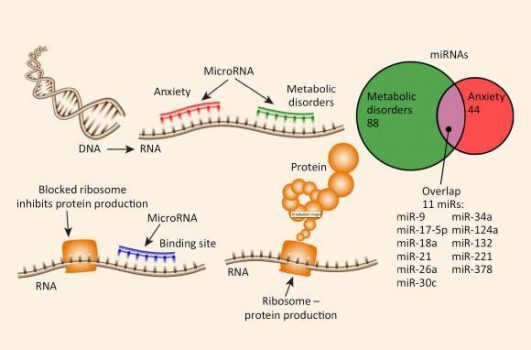
The family of microRNA genes is part of the human genome, which was considered until not too long ago as ‘junk-DNA.’However, microRNAs are now known to fulfill an important role in regulating the production process of proteins by other genes. These small, highly conserved molecules act as suppressors of inflammation and are able to halt the production of proteins.A new research paper, by Prof. Hermona Soreq, a researcher at the Hebrew University of Jerusalem, and her colleagues from Tel Aviv University and Tel Aviv Sourasky Medical Center, details the evidence linking microRNA pathways, which share regulatory networks in metabolic and anxiety-related conditions.
In particular, microRNAs involved in these disorders include regulators of acetylcholine signaling in the nervous system and their accompanying molecular machinery.
“We already know that there is a connection between body and mind, between the physical and the emotional, and studies show that psychological trauma affects the activity of many genes,” said Prof. Soreq, whose new study was published in the journal Trends in Molecular Medicine.“Our previous research found a link between microRNA and stressful situations — stress and anxiety generate an inflammatory response and dramatically increase the expression levels of microRNA regulators of inflammation in both the brain and the gut, for example the situation of patients with Crohn’s disease may get worse under psychological stress.”
“In the present study, we added obesity to the equation,” Prof. Soreq explained.“We revealed that some anxiety-induced microRNA are not only capable of suppressing inflammation but can also potentiate metabolic syndrome-related processes.”“We also found that their expression level is different in diverse tissues and cells, depending on heredity and exposure to stressful situations.”
Metabolic syndrome holds a growing stance in the population world-wide, with a prevalence reaching 35% in the United States. It is characterized by abdominal obesity, dyslipidemia, hypertension, and diabetes, conditions often accompanied by proinflammatory and pro-thrombotic states.
This syndrome is a global epidemic, not an entity limited by geography or ethnicity, as shown by studies in India, South Korea and China. Other countries such as Australia, Denmark, and Ireland also suffer from a high disease burden, affecting 20–25% of the population.
Anxiety disorders are harder to quantify than metabolic ones. They encompass the severe but uncommon obsessive-compulsive disorder (OCD) and post-traumatic stress disorders (PTSD), as well as milder common phenomena such as phobias.
The newly-discovered link offers novel opportunities for innovative diagnoses and treatment of both metabolic and anxiety-related phenomena.“The discovery has a diagnostic value and practical implications, because the activity of microRNAs can be manipulated by DNA-based drugs,” Prof. Soreq said.“It also offers an opportunity to reclassify ‘healthy’ and ‘unhealthy’ anxiety and metabolic-prone states, and inform putative strategies to treat these disorders.”
SOURCE…www.newsmasterapp.com
