Imagine a conference championship game five or 10 years from now. The road team, having traveled to London and Las Vegas for its previous playoff games, arrives in Foxborough and engineers a shocking upset with the help of a surprising strategy: Even though the team’s quarterback is an All-Pro known for picking apart defenses, it employs a scaled-back, run-heavy game plan.
The head coach explains his daring tactical shift at the postgame press conference. “Well, Deshaun’s sleep hygiene has been terrible because of all our travel,” he says. “Our monitors recorded a 37 percent reduction in high-order decision-making because of poor sleep. Meanwhile, Ezekiel’s sleep hygiene has been great, speeding his recovery from that high ankle sprain. So we decided to pound the ball between the tackles.”
Coaching decisions based on sleep habits? Precision monitoring of players’ sleep and how it affects their health and performance? “Sleep hygiene?”
Does sleep even make that much of a difference, assuming a player got at least a little of it in the 48 hours before kickoff?
It turns out that sleep is the next frontier of NFL performance. Sports scientists around the world are studying it. Companies are designing new products to monitor it. Sleep is becoming the elite athlete’s secret weapon, and the NFL is just starting to discover how to harness its potential.
Learning the Language of Sleep
Gary McCoy, a sports science consultant for many NFL teams over the last few years, watched a pair of receivers sweat their way through a training camp session in 2015. One receiver was a celebrated veteran, the other a speedy young up-and-comer. Both wore high-tech sensors that monitored their heart rates, body temperatures and physical stresses during the intense practice. The sensors confirmed that the stress data for each receiver was roughly equal: Practice was just as hard for both of them.
But after practice, the veteran was ready for a full weight-room session. The younger player was gassed. If there was no difference in practice difficulty, shouldn’t it have been the other way around? McCoy realized that the sensors were missing an important aspect of athletic performance.
“We’re measuring stress,” he said. “But what’s more important is stress response.”
There is still a lot of mystery surrounding sleep. Sleep science is a new science. Until a few years ago, there were only two ways to monitor sleep: polysomnography, the expensive, cumbersome lab equipment that placed participants in uncomfortable and unfamiliar locations (thus immediately affecting their sleep patterns); or unreliable surveys of the I slept about eight hours last night, doc variety that had little chance of yielding precise results.
The rise of wearable wrist tech has revolutionized sleep study. Your everyday Fitbit provides a wealth of information, so much that your in-law can post their bad night’s sleep data on Facebook as a warning to everyone that she’s going to have a crabby day.
NFL teams are notoriously more secretive about their training programs and sports science initiatives. But they do exist.
WHOOP, the company for whom McCoy works, has developed wearable tech that includes a sophisticated sleep monitoring system that measures the length and quality of a night’s sleep and converts it into an easy-to-interpret quality score.
Another company selling sleep monitors to the NFL, Fatigue Science has developed the ReadiBand sleep tracker and SAFTE bio-mathematical fatigue model software in conjunction with the U.S. Army Research Lab and Johns Hopkins University. The system “translates all the complexity and nuance around a person’s sleep into a performance prediction,” according to sales director Jacob Fiedler.
The NFL and American team sports in general have been slow to join the sleep science revolution. Chip Kelly was well-known for his sleep science initiatives in Philadelphia, though he scrapped the monitoring program in favor of a voluntary reporting program last year. And while Fatigue Science officially consults with the Seattle Seahawks, most relationships between NFL teams and sleep-monitor vendors are off the record. B/R found, however, that at least a dozen teams have recently explored some kind of sleep monitoring program.
The quiet embrace of studying slumber is not new in sports, particularly on the international scene. Nick Littlehales was a mattress company executive consulting with Premier League superpower Manchester United several years ago to help players with chronic back pain (and, he hoped, secure a few endorsements). When he became a familiar face around team headquarters, the British soccer press (which can make the NFL media look like a litter of kittens) took notice.
“The paparazzi wrote: Those pampered Manchester United players have got a sleep coach who’s tucking them in and reading them bedtime stories,” Littlehales joked. “So I became the Sleep Coach by default.”
The laughs died down as other football clubs began investigating the link between sleep and performance. Sleep Coach Littlehales has performance monitors and bedding products for sale, but he also designs seminars for players, coaches and teams.
“Working with elite athletes, you have to define a language,” he said. “If you tell them you’re a sleep coach, they’ll run a mile. It’s not something they’re very interested in.”
One of the first terms athletes and teams learn in that new language is sleep hygiene, the habits that lead to healthy sleep, from limiting caffeine and alcohol intake to monitoring the temperature and humidity of the bedroom to scaling back on nighttime smartphone use. There is other not-too-familiar terminology to master, including circadian rhythms (the biological 24-hour cycles that dictate everything from brain wave activity to digestion) and polyphasic sleep (multiple naps instead of an eight-hour sleep session: important for soldiers, astronauts and athletes on crazy travel schedules).
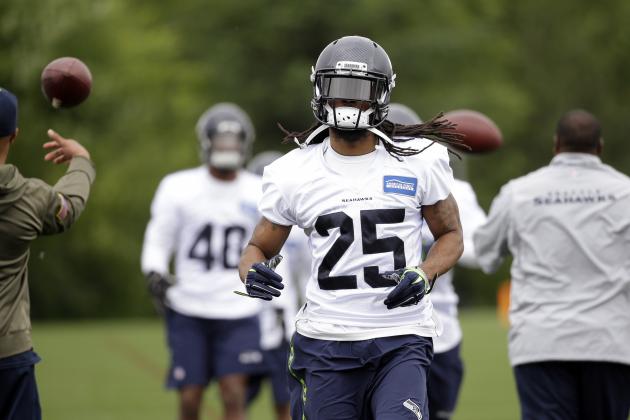
Some NFL players are starting to speak the language. Fatigue Science’s products are the ones Richard Sherman cited in a guest Sports Illustrated column after the Seahawks won the Super Bowl in 2014. “We have specialized doctors who monitor us for concussion symptoms and wrist wear that helps the team track our sleep patterns,” Sherman wrote.
He added in a parenthetical aside: “In case you’re wondering, the sleep science has paid off for several guys.”
Sherman is not alone among players in embracing sleep science. “You’ve always heard you need eight hours of sleep, but you don’t know the science behind it all,” Eagles safety Malcolm Jenkins told B/R in an offseason interview. “You don’t know until you’re taught the effect lack of sleep has upon your brain and its functionality. It changes completely when you’re sleep-deprived.” Jenkins includes a discussion of the importance of sleep to health and recovery as part of his youth football camps.
Star fitness trainer Brett Bartholomew, who has worked with Von Miller, Rob Gronkowski and others during the offseason, is on board with the sleep revolution. “Rest is a weapon,” he told Brad Stulberg of Outside Magazine. “What was once seen as a weakness is now a strength.” Bartholomew recommends massage and relaxing music, but “all of that stuff pales in comparison to sleep,” he says. “Just like you eat to support your training you need to sleep to support your training.”
In a 2015 feature for TheMMQB.com, Jenny Vrentas revealed that many NFL veterans are strict about their sleep routines, including Tom Brady, who has a 9 p.m. bedtime.
J.J. Watt is so dedicated to recovery science that he told Men’s Healthmagazine he naps in a flotation tank. “I love it. Sleep is something people overlook,” Watt says.
It sounds like a lot of technology, jargon and effort to emphasize something your grandma could have told you. But there is a lot more to sleep than just going to bed on time and waking up refreshed, especially for athletes who must travel coast-to-coast, sleep in unfamiliar hotels and make sure they are mentally and physically ready for kickoff.
Nature’s Performance Enhancer
When Dr. Shona Halson, senior recovery physiologist of the Australian Sports Commission, writes that “REM sleep is considered an activated brain inside a paralyzed body,” it sounds more like the stuff of horror movies than a natural, everyday (or every night) part of life.
More than the scary description, there are excellent reasons to rush toward a better understanding of sleep.
First, sleep disorders like apnea can be potentially life-threatening, they plague huge men (like football players), and they often go undetected by individuals who just think they “don’t sleep well.” Wrist monitors are not quite foolproof enough to diagnose a disorder, but they can point an athlete and his family, coaches or doctors toward a potential problem.
“A percentage of the whole adult population is dealing with something that has probably not been diagnosed or treated,” Fiedler said. “It can obviously have a huge impact on your life and health.”
Second, athletes who are too amped to sleep before and after the big game too often turn to pills. “A lot of times I go into an organization because the doctor was giving out 100 sleeping tablets every season, but now it’s up to a thousand'” Littlehales said. “And he wants to stop it.” A more scientific approach to sleep can lead athletes to better solutions.
Finally, and most excitingly, there’s sleep’s potential as what Halson calls a “natural performance enhancer.” Studies show that the body produces HGH while we sleep. Proper sleep doesn’t just make you more alert. It helps your body heal and grow. It can decrease recovery time for injuries and, like those receivers McCoy studied in training camp last year, it can increase offseason workout capacities.
There are also common-sense benefits to sleep that are still being quantified. Researchers have discovered that basketball players who take steps to improve their sleep habits become better free-throw shooters. Athletes who haven’t had enough sleep report increased fatigue and slower reactions. The WHOOP device calculates a cognitive marker to determine which players have had too little sleep to be of much use in the film room. “It can tell that this quarterback is ready for this level of cognitive information, but this one isn’t,” McCoy explained.
Still, the research is still in its infancy. The technology is still new, and no NFL players or international soccer stars are about to purposely go sleep-deprived before a big game or match in the name of science.
There is another impediment to the advancement of sleep science. The wearable tech may be too good, providing too much information to too many people too easily.
All the experts agree that there’s little good that can come from the rookie quarterback who checks his monitor the morning of the big game, realizes his night’s sleep was horrible and ends up with one more thing to worry about. For now, that isn’t an issue. The various devices being marketed to NFL teams will only send information to the team the night before kickoff, not the player himself.
But that raises another potential problem: how much information about the player’s sleeping habits should a team have access to? The issue translates easily into our own lives. How much information about your bedroom habits—bedtime, heart rate changes, respiration changes, body temperature changes, think about it—do you want your boss to have access to?
Wait … forget the boss. “The last thing we want is a player’s wife to get access to this information and ask: ‘Why weren’t you recovered for those two days you were on the road?'” McCoy acknowledged.
Little Interventions
Concerns over the scope of the information led the NFL Players Association to file a grievance regarding sleep monitors last October, stating that “because the use of such technology occurs outside of games and practice, we believe such use violates the Collective Bargaining Agreement.” Basically, the NFLPA contends that while teams have the right to monitor all sorts of body functions during practice, that right does not extend into the player’s bedroom.
The grievance was quietly settled over the summer. Teams can institute roster-wide monitoring as long as they receive NFLPA consent for the program. The Seahawks are currently the only team openly using sleep monitors on a roster-wide basis, as the New York Times‘ Ken Belson reported Saturday.
The policy change reflects both technological advancementss and the increased acceptance of wearable tech in the marketplace in recent years.
The makers of wearable tech understood the potential privacy concerns and created safeguards to resolve them. WHOOP doesn’t make the “granular” data available to the team, just a Recovery Score that places the night’s sleep into green-yellow-red categories. “They really don’t want to monitor your in-bed activities,” McCoy said.
Fiedler points out that the collective bargaining agreement was written back in 2011, when no one would have imagined everyday consumers wearing a Fitbit on their morning jogs. “Largely, they were uninformed about what data is actually being collected and how it’s being used, and what safeguards are in place to protect the players’ privacy,” he said of the resistance to team-wide monitoring.
The fear that the minute-by-minute bedroom events in the life of (let’s say) Rob Gronkowski might wind up in the hands of Roger Goodell or TMZ.com will keep the NFLPA on guard. There are also plenty of old-school coaches who scoff at the notion of newfangled “sports science” offering anything the fellas couldn’t get from good ol’ free weights and medicine balls.
But the gizmos are really only a small part of the full sleep science picture. “It’s about education,” Littlehales said. “It’s about raising awareness. It’s about techniques. It’s about little interventions.”
Littlehales’ seminars focus on teaching athletes to think of sleep in terms of cycles, not hours. Typically, a person goes through five cycles of different kinds of sleep (light, deep, REM) in eight hours. Instead of striving for eight hours per night, athletes and their coaching staffs can aim for 35 cycles per week, counting naps.
So, say a team like the Seahawks faces a playoff schedule that takes them from Seattle to Minneapolis to Seattle to Charlotte. Between long flights, jet lag, unfamiliar hotels and pre- and postgame adrenaline, eight-hour nights of sleep might be rare. But coaches can alter practice schedules and require nap periods, while players can learn how to better control their sleep patterns by monitoring caffeine intake, doing a little midnight yoga and so forth.
“They need to look at sleep in a polyphasic way,” Littlehales said. “They have to put their sleep in at different times to meet their schedules.”
Athletes who buy into sleep science quickly develop better habits. McCoy’s research of international athletes who used sleep monitors and learned some sleep hygiene basics revealed that they slept an extra 41 minutes per night on average, reduced their alcohol intake 70 percent and reduced their caffeine intake 60 percent. “It was mind-blowing,” McCoy said.
It’s a sign of the times that the one behavior that budged the least is the use of electronic devices, which have become the 21st century’s sneakiest sleep thieves. Coffee and booze proved easier to quit than late-night Twitter or Call of Duty. Still, sleep monitoring decreased electronic usage by 20 percent, according to the research.
Elite athletes can begin to strive for an excellent sleep score the same way they seek improvements on the track or in the weight room. “For the athletes that want it and embrace it, it’s something tangible,” Fiedler said of sleep science. “They get so many things thrown at them during the days and weeks of the preseason and the regular season. There’s something to the logic of providing them the right information in the right way.”
Teach a football player how and why to sleep better, and he will sleep better, whether his nighttime heart rates stream directly to Jerry Jones’ laptop or not. And once he’s sleeping better, he will start thinking better, recovering better and performing better.
Littlehales can foresee a scenario in which coaches use sleep analysis to make strategic decisions. “The captain’s got to be out there leading the team. But at the moment, he’s at 70 percent recovery. He’s also a night person, and this game is kicking off at night. What we need is a set of things in place so we don’t expose it,” Littlehales theorized.
In the meantime, NFL players and coaches are learning the language of sleep. Once they do, it’s on the field where the effect of sleep science will be most obvious and dramatic.
“The superhumans are still in our sports, McCoy said. “We’re just going to find out how superhuman they are.”
SOURCE…www.bleacherreport.com